
On this page
- Why discharge matters
- Foundations in Franklin
- Options from simplest to biggest
- Buried drain lines done right
- Rain gardens and stormwater
- Signs of poor drainage
- Drainage parts
- When it is more than downspouts
- Questions to ask
- A step-by-step drainage check
- Grading basics
- Typical Franklin situations
- Common drainage mistakes
- Discharge and neighbors
Why discharge matters
A roof sheds a lot of water. A 2,000-square-foot roof collects roughly 1,250 gallons from an inch of rain, and every gallon goes out through a handful of downspouts. If they release it beside the foundation, that water soaks the soil right where you least want it: against crawl space walls, basement walls or a slab edge.
Foundations in Franklin
Franklin houses sit on crawl spaces, slabs and basements, depending on age, lot and builder. Each reacts to downspout water differently.
| Foundation | What poor discharge does |
|---|---|
| Crawl space | Damp air, standing water, wet insulation, rot in sills |
| Basement | Seepage at walls and joints, wet window wells |
| Slab | Washed-out soil at the edge, water at doors and garage |
| Walkout on a slope | Water running toward the lower doors |
Options from simplest to biggest
| Option | What it does | Best for |
|---|---|---|
| Splash block | Spreads water at the base | Ground that slopes away well |
| Extension | Carries water several feet out | Most houses |
| Flip-up extension | Folds up for mowing | Lawns |
| Buried drain line | Runs underground to an emitter | Beds, walks, long distances |
| Rain garden | Lets water soak into a planted bed | Lawns with room |
| Rain barrel | Stores some water for garden use | Small roof sections |
| Regrading | Slopes soil away from the house | Ground sloping toward the house |
Buried drain lines done right
- Use smooth-wall pipe, not crushable corrugated, where possible.
- Keep a steady fall so water does not sit.
- Add a cleanout near the downspout.
- End at an emitter or daylight outlet in the lawn, well away from the house.
- Avoid tying into a footer drain; roof water can overwhelm it.
Rain gardens and stormwater
Franklin's stormwater program promotes practices such as rain gardens that let water soak in on the lot rather than rushing to streets and creeks. The city's stormwater pages cover drainage questions and rules. Pointing a downspout toward a planted low spot can turn a nuisance into a garden.
Signs of poor drainage
- Wet or musty crawl space after rain.
- Water marks on basement walls.
- Soil washed out at the end of a downspout.
- Mulch that floats away from beds.
- Puddles near the foundation a day after rain.
- Cracks in walks or patios near downspouts.
Drainage parts
| Part | Meaning |
|---|---|
| Downspout | The pipe that brings water down, commonly 2x3 or 3x4 inches, or round on half-round systems |
| Extension | An added length that carries water away from the foundation |
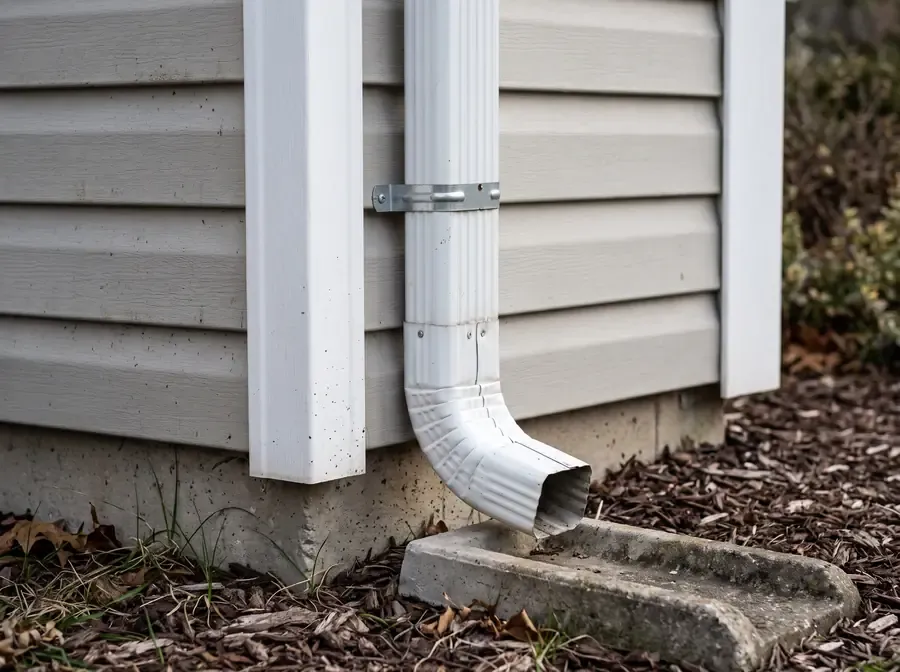
| Splash block | A pad under the downspout that spreads the flow |
| Buried drain line | Pipe run underground from the downspout to a pop-up or an open outlet |
| Pop-up emitter | A spring lid at the end of a buried line that lifts to let water out |
| Cleanout | A removable fitting that gives access to clear a clog |
When it is more than downspouts
Gutters and downspouts handle roof water. Ground water, springs, high water tables and river flooding are different problems. Franklin's flooding information explains floodplain issues along the Harpeth. Crawl space vapor barriers, sump pumps and French drains are separate jobs for a drainage or waterproofing contractor.
Questions to ask
- Where will each downspout release water?
- How far out will extensions or lines go?
- Will buried lines have a cleanout?
- Does the ground slope away?
A step-by-step drainage check
- Walk the house in a hard rain with an umbrella and note where each downspout empties.
- Look at the ground for a slope away from the house over the first several feet.
- Check beds and mulch for washouts and for soil built up against siding.
- Look in the crawl space or basement after rain for water, damp walls or musty smells.
- Mark problem downspouts and fix the worst first with an extension or buried line.
Grading basics
Soil next to the house should fall away from the wall. Over the years beds get built up and soil settles, so the ground often ends up sloping toward the house. Pulling soil back and building it up a few feet out restores the fall. Keep soil and mulch below siding and weep holes.
Typical Franklin situations
| Situation | Usual fix |
|---|---|
| Downspout into a bed by the crawl space vent | Extension or buried line past the bed |
| Downspout onto a driveway | Redirect to lawn |
| Sloping lot with a walkout | Carry water to the downhill side |
| Narrow side yard between houses | Buried line to front or back |
| Big lawn | Rain garden at a low spot |
Common drainage mistakes
- Burying downspouts into crushable corrugated pipe that collapses or clogs.
- Running roof water into a foundation footer drain.
- Ending a buried line under a bed where it cannot drain out.
- Piling mulch higher than the siding.
Discharge and neighbors
On close-set lots, water released at the side of one house can run onto the next. Point extensions toward the front or back of the lot, use buried lines to reach the street side or a lawn, and keep water from crossing property lines onto neighbors.