
On this page
- When replacement makes sense
- How replacement is done
- Upgrades worth considering
- Replacement after storm damage
- Replacement on historic houses
- Parts that change
- Cost
- Questions to ask
- Replacement on typical Franklin houses
- What to expect on the day
- Replacement terms
- Comparing replacement quotes
- Signs it is time to replace
- Replacement and the rest of the house
When replacement makes sense
Replacement means removing the existing gutters and downspouts and putting up a new system. It is the right call when the trouble is everywhere rather than in one spot. A house built in the 1980s or 1990s may still have its first gutters: often 5-inch, sometimes sectional, with 2x3 downspouts that can struggle in a summer storm.
| What you notice | What it tells you |
|---|---|
| Leaks at most corners and seams | The sealant is failing everywhere |
| Sags along most runs | Fastening has failed system-wide |
| Overflow in every heavy rain | The gutters or downspouts are undersized |
| Dents or bends along many runs | Slope and joints are compromised |
| Rust holes in steel | The coating is gone |
| Soft fascia in long stretches | Water has missed the gutter for years |
How replacement is done
- Measure and plan: size, metal, gauge, hanger spacing and downspout positions.
- Take down the old gutters and downspouts and haul them off.
- Inspect and repair the fascia, soffit and drip edge.
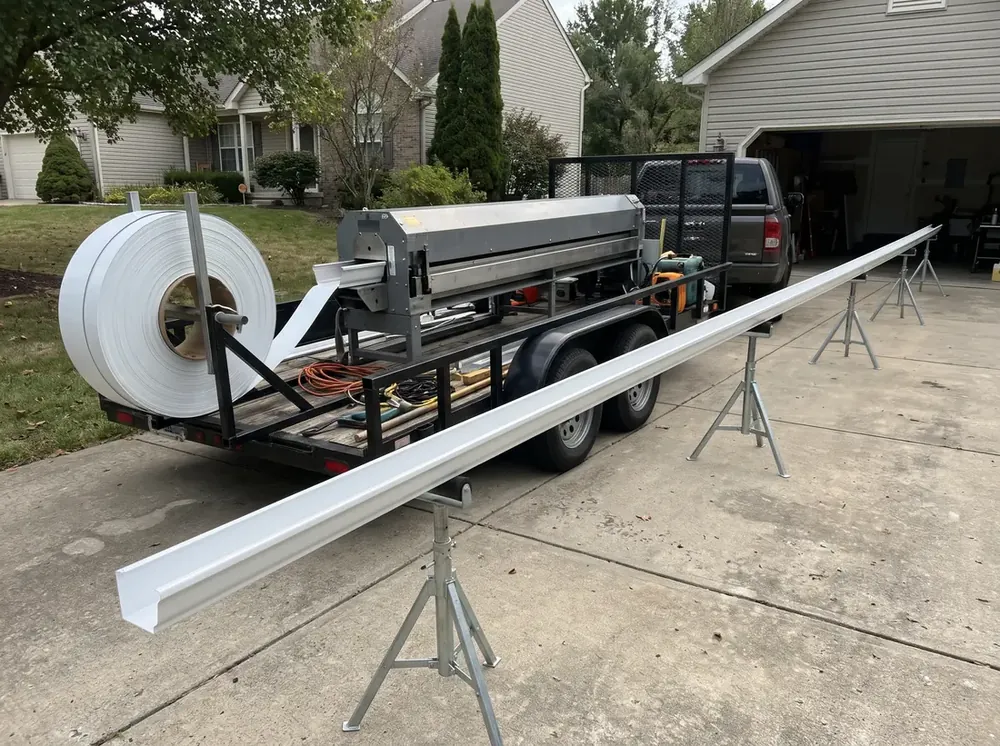
- Roll and hang new seamless runs on hidden hangers at the right fall.
- Fit outlets, corners and end caps, sealed.
- Install downspouts with extensions or buried lines that discharge well away.
- Test with water.
Upgrades worth considering
| Upgrade | Benefit in Franklin |
|---|---|
| 5-inch to 6-inch | Handles summer cloudbursts |
| 2x3 to 3x4 downspouts | Fewer clogs, faster drainage |
| .027 to .032 aluminum | Resists hail and ladder dents |
| Spikes to hidden hangers | Holds under wet leaves and wind |
| Extra downspouts | Shorter runs, less load per outlet |
| Buried drain lines | Keeps water away from crawl spaces and basements |
| Micro-mesh guards | Less cleaning under big trees |
Replacement after storm damage
Hail and wind are common reasons for replacement here. On May 26, 2024 the National Weather Service received hail reports up to 2.25 inches west of Franklin, and in 2025 3-inch hail was measured in Franklin. Damage to gutters often comes with damage to shingles and siding. See storm damage.
Replacement on historic houses
Franklin has seven local historic districts. Within them, the Historic Zoning Commission reviews exterior changes covered by its design guidelines and issues Certificates of Appropriateness, with some minor work approved by staff. Check before switching profiles or materials. See gutters on historic homes in Franklin.
Parts that change
| Part | Meaning |
|---|---|
| Drip edge | Bent metal strip at the edge of the roof deck that steers runoff into the trough |
| Gutter apron | A wide flashing that slides under the first shingles and laps down into the gutter |
| Hidden hanger | An internal bracket that clips to the gutter lip and screws through the back into the fascia |
| Outlet | The hole and flanged drop that feeds a downspout |
| Downspout | The pipe that brings water down, commonly 2x3 or 3x4 inches, or round on half-round systems |
| Extension | An added length that carries water away from the foundation |
| .032 aluminum | A heavier coil that resists dents and stays straighter between hangers |
Cost
Replacement is priced like a new installation, per foot, plus removal and any fascia work. National guides put seamless aluminum at around $9 to $13 a foot for 5-inch and $12 to $18 for 6-inch (Angi, This Old House). These are national ranges. See the Franklin cost guide.
Questions to ask
- Is removal and disposal included?
- How will rotten fascia be handled and priced?
- Are you quoting the same size as now, or an upgrade, and why?
- What gauge and hangers?
- Where will every downspout empty?
- For a historic property, who obtains the approval?
Replacement on typical Franklin houses
| House | Usual replacement |
|---|---|
| 1990s brick home with original gutters | Seamless 5 or 6-inch on hidden hangers, 3x4 downspouts |
| 2000s two-story with bonus room | 6-inch on main and lower roofs, extra outlets |
| Older house downtown | Half-round, copper or dark aluminum, fascia repair |
| Home after hail | Matching or upgraded system, often via a claim |
| Rural home | 6-inch seamless, long discharge |
What to expect on the day
- Old gutters taken down and hauled away.
- Fascia checked and soft boards replaced.
- Drip edge checked and added or extended.
- New runs formed on site and hung on hidden hangers.
- Downspouts fitted and strapped.
- Extensions or buried lines set.
- Water test and walk-through.
Replacement terms
| Term | Meaning |
|---|---|
| K-style gutter | The most common modern profile: flat back, decorative front, 5 or 6 inches wide |
| Half-round gutter | A tube cut in half, hung on brackets; typical of older houses |
| Hidden hanger | An internal bracket that clips to the gutter lip and screws through the back into the fascia |
| Miter | A corner joint where two runs meet, made from a strip, a box piece or cut by hand |
| Outlet | The hole and flanged drop that feeds a downspout |
| Drip edge | Bent metal strip at the edge of the roof deck that steers runoff into the trough |
| .032 aluminum | A heavier coil that resists dents and stays straighter between hangers |
Comparing replacement quotes
Line up sizes, metals, gauge, hanger type, number of downspouts, extensions, fascia allowance and removal. A cheaper quote that leaves out downspouts or removal may not be cheaper. National guides from Angi put 5-inch seamless aluminum at about $9 to $13 a foot installed.
Signs it is time to replace
- Leaks at most joints.
- Spikes pulling out along every run.
- Overflow in every hard rain, even when clean.
- Rust through steel gutters.
- Widespread hail or limb damage.
Replacement and the rest of the house
Gutter replacement is a good time to look at the fascia, soffit and drip edge, to check that the ground slopes away from the house, and to set extensions or buried lines. Doing all of that together costs less than coming back for each later.