
On this page
- What is involved in a new gutter installation?
- Step by step: how a good installer works
- Gutter sizes and profiles
- Choosing a metal
- Seamless or sectional?
- What is different about installing gutters in Franklin?
- Installation services
- What installation costs
- Questions to ask an installer
- New gutters on new construction
What is involved in a new gutter installation?
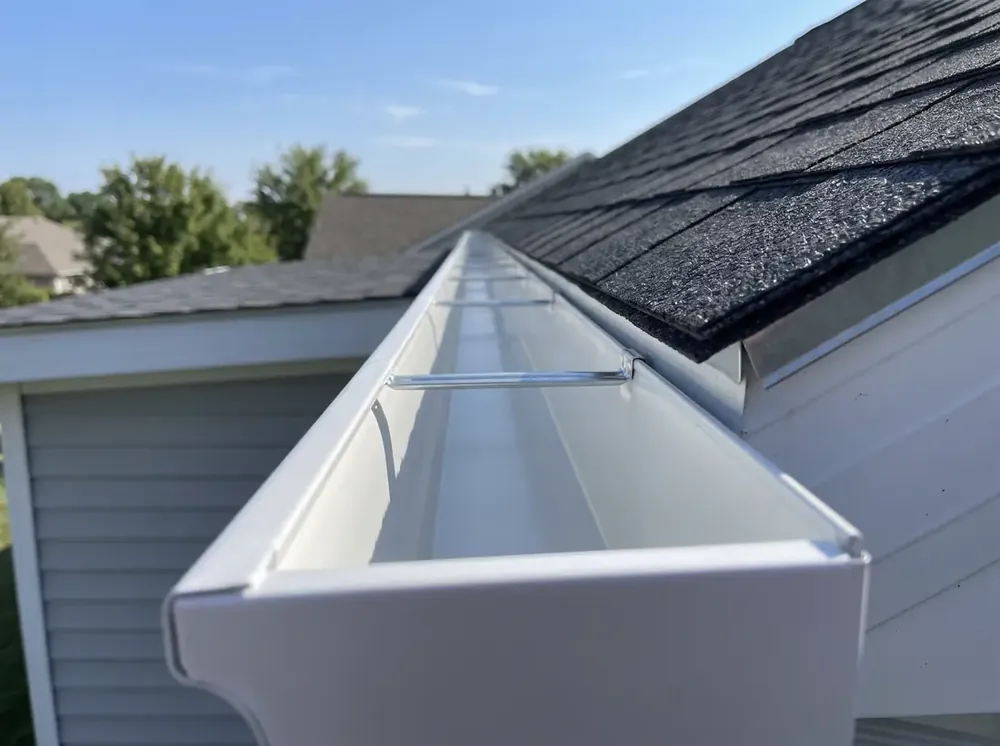
A gutter installation fits a whole drainage system to the roof edge: the trough that catches runoff, the hangers that hold it on a slight fall, the outlets and downspouts that bring water to the ground, and the extensions that take it away from the house. Most Franklin homes get seamless aluminum, rolled from a coil on a machine the installer brings on a trailer, so each eave gets one continuous piece. Joints exist only at corners, ends and outlets.
The planning matters as much as the hardware. The installer has to judge how much water each roof plane sheds, where downspouts can go without dumping onto a walk or into a crawl space vent, and where the water can finally drain. In Franklin the deciding factor is usually the size of a summer storm.
Step by step: how a good installer works
- Remove the old system and haul it off.
- Inspect the fascia and roof edge, replacing soft boards and checking that the drip edge will lap into the new gutter. See fascia and soffit.
- Plan the outlets around the roof area each run drains and the places water can safely be let go.
- Mark the slope with a chalk line, usually about a quarter inch of fall in ten feet.
- Roll each run from coil to the measured length.
- Cut outlets, fit end caps and form the corners, sealing every joint.
- Hang the runs on hidden hangers, about every two feet and closer at corners and under valleys.
- Attach downspouts with elbows and straps, then add extensions or buried lines.
- Test with a hose and watch each joint and outlet.
Gutter sizes and profiles
| Part | Meaning |
|---|---|
| K-style gutter | The most common modern profile: flat back, decorative front, 5 or 6 inches wide |
| Half-round gutter | A tube cut in half, hung on brackets; typical of older houses |
| Box gutter | A deep rectangular gutter, often built into the eave on older or commercial buildings |
| Downspout | The pipe that brings water down, commonly 2x3 or 3x4 inches, or round on half-round systems |
| Outlet | The hole and flanged drop that feeds a downspout |
| Gutter | Downspout | Best for |
|---|---|---|
| 5-inch K-style | 2x3 inch | Single-story roofs, short runs, few valleys |
| 6-inch K-style | 3x4 inch | Two-story homes, steep or large roofs, valleys |
| 5 or 6-inch half-round | 3 or 4-inch round | Older and historic houses, copper |
| 7-inch K-style or box | 4x5 inch and up | Commercial and very large roofs |
Nashville, the nearest official station, gets about 50.51 inches of precipitation a year, with May the wettest month, and the city's records include nearly an inch of rain in five minutes. That kind of intensity is why many larger Franklin homes get 6-inch gutters. The 5-inch vs 6-inch guide helps you decide.
Choosing a metal
| Metal | Thickness | Dent resistance | Notes |
|---|---|---|---|
| Aluminum | .027 or .032 inch | Moderate; .032 better | Most common, many colors, will not rust |
| Galvalume or galvanized steel | 26 or 24 gauge | High | Heavy; cut edges can rust |
| Copper | 16 or 20 oz | Moderate | Half-round on brick, stone and period homes |
| Vinyl | Sections | Low | Sectional only; sun and cold make it brittle |
Most homes get aluminum gutters. Where hail is a worry, .032 aluminum or steel holds up better. Copper gutters suit older brick houses downtown and in Hincheyville. Compare them in the metals guide.
Seamless or sectional?
Sectional gutters are joined every 10 or 20 feet, and each slip joint relies on sealant. Seamless gutters have none along the run. Franklin summers bake sealant and winters crack it, so fewer joints means fewer leaks. See seamless gutters and seamless vs sectional.
What is different about installing gutters in Franklin?
Intense rain. Summer storms dump a lot of water fast. Capacity at the outlet matters most.
The Harpeth River. Franklin is built along the Harpeth, which reached a record 35.32 feet in downtown Franklin in May 2010. Gutters cannot hold back a river, but on low lots they decide whether the roof adds to the water beside the foundation.
Wind and trees. Straight-line winds and falling limbs are the common storm damage here. Close hanger spacing and strapped downspouts help.
Historic districts. In Franklin's local historic districts, exterior work covered by the design guidelines needs a Certificate of Appropriateness, and the city's guidelines describe half-round gutters as typical of pre-1960 houses.
Installation services
What installation costs
Gutters are priced per linear foot installed. National guides from Angi, Angi on seamless gutters and This Old House put seamless aluminum around $9 to $13 a foot for 5-inch and $12 to $18 for 6-inch, steel around $6 to $14, and copper around $25 to $40. These are national figures, not local quotes.
| What moves the price | Why |
|---|---|
| Total footage | Most of the price is per foot |
| 5-inch or 6-inch | Bigger gutter, bigger downspouts |
| Metal and gauge | Heavier aluminum, steel and copper cost more |
| Height and pitch | Two-story and steep roofs take longer |
| Corners and outlets | More joints, more labor |
| Fascia repair | Rotten boards replaced first |
| Removal | Old gutters taken down and hauled off |
| Guards | Priced per foot on top |
The Franklin cost guide has worked examples.
Questions to ask an installer
- Which size gutter and downspout are you quoting, and why?
- What metal, gauge and color?
- What hangers, at what spacing?
- How many downspouts, where will each empty, and are extensions included?
- How will you form and seal the corners?
- What happens if the fascia turns out to be rotten?
- Is removing the old gutters included?
- For a historic house, will you handle the city review?
New gutters on new construction
On a new build or addition, gutters go up after the roof and trim and before final grading. Ask the builder about 6-inch gutters, 3x4 downspouts and buried lines planned with the landscaping, since adding them later costs more.