
On this page
- What micro-mesh guards are
- Why it suits Franklin's trees
- How it is fitted
- Living with micro-mesh
- Which Franklin homes benefit most
- Guard terms
- What to ask
- Micro-mesh on a typical Franklin house
- How micro-mesh compares on cost
- Fitting on older gutters
- What happens in heavy rain
- Mesh, valleys and corners
- Common micro-mesh mistakes
- What micro-mesh will not fix
What micro-mesh guards are
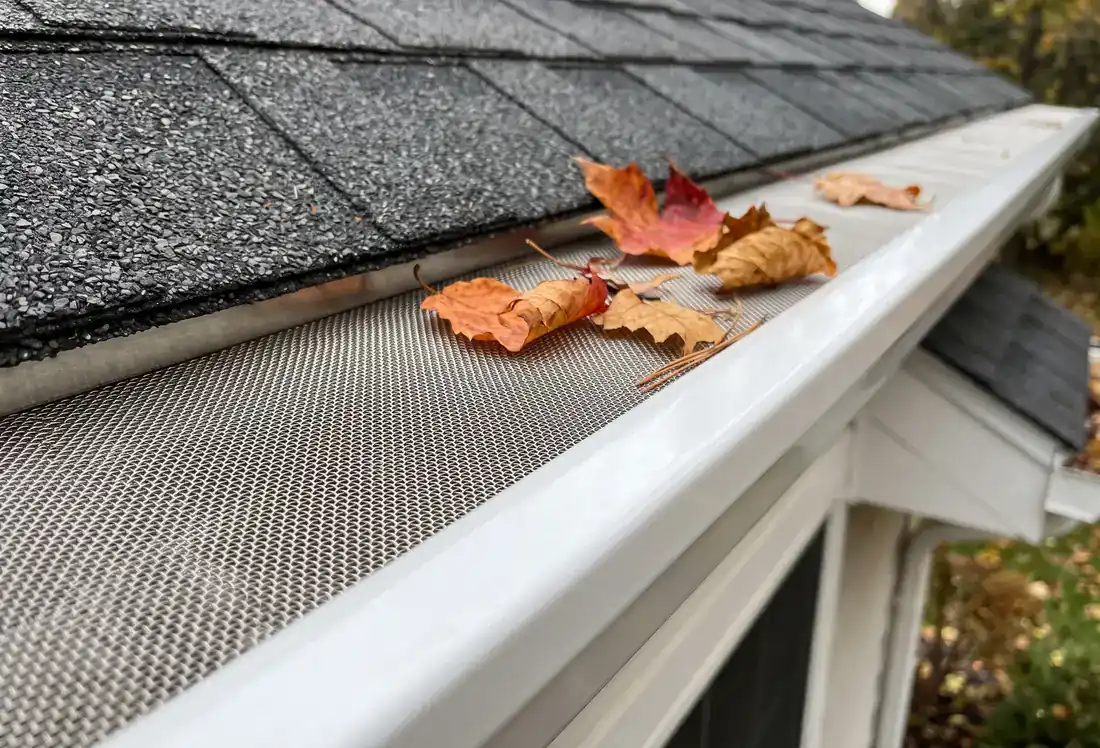
A micro-mesh guard is a frame, usually aluminum, holding a fine stainless steel mesh over the trough. Water soaks through; leaves, seeds, needles and grit stay on top where they dry and blow off or are brushed away.
Why it suits Franklin's trees
| Debris | Coarse screen | Micro-mesh |
|---|---|---|
| Oak and maple leaves | Stopped | Stopped |
| Maple and elm seeds | Get through | Stopped |
| Oak catkins | Get through | Stopped |
| Pine and cedar needles | Poke through | Stopped |
| Sweetgum balls | Sit on top | Sit on top |
| Shingle grit | Gets through | Mostly stopped |
| Pollen | Gets through | Can film over |
How it is fitted
- Repair the gutters first: hangers, corners, slope.
- Clean the troughs and flush the downspouts.
- Attach the guard to the front lip and back edge.
- Finish corners and valleys without gaps.
- Test with water, including heavy flow from valleys.
Living with micro-mesh
- Brush or blow off the top when leaves pile up.
- Hose off spring pollen film.
- Have troughs and downspouts checked every year or two.
- In the heaviest downpours some water may run over a matted guard.
Which Franklin homes benefit most
| Situation | Why |
|---|---|
| Two-story under big oaks | Fewer ladder trips |
| Pines or cedars near the roof | Needles kept out |
| Wooded lots in Westhaven, Ladd Park or Leiper's Fork | Heavy, year-round debris |
| Downspouts that clog every spring | Less debris reaches the elbows |
Guard terms
| Term | Meaning |
|---|---|
| Micro-mesh guard | Fine stainless mesh on a frame that stops seeds, needles and grit |
| Screen guard | Perforated or expanded metal cover with larger openings |
| Reverse-curve guard | A solid hood that curls water around its nose into a slot |
| Gutter insert | Foam or bristle filler laid inside the trough |
| Drip edge | Bent metal strip at the edge of the roof deck that steers runoff into the trough |
| Valley diverter | A small baffle that keeps fast valley water from shooting past the gutter |
What to ask
- Is the mesh stainless steel?
- How does it attach?
- How are corners and valleys finished?
- Is cleaning or gutter repair included?
- Who stands behind the guard and the installation?
See are gutter guards worth it?
Micro-mesh on a typical Franklin house
| House | How micro-mesh fits |
|---|---|
| Two-story under oaks, as in Fieldstone Farms | All eaves; worth the cost because of ladder height |
| Home backing onto woods, as in Ladd Park | Eaves facing the trees |
| Historic house with half-round | Only where a half-round product is available |
| New subdivision with young trees | Usually not yet needed |
How micro-mesh compares on cost
Micro-mesh usually costs more per foot than screens and less than or similar to premium hoods. What it saves is cleaning: on a two-story house under big trees that would otherwise need three cleanings a year, the guard can pay for itself in a few years.
Fitting on older gutters
Guards work only on gutters that are sound, sloped and well fastened. If corners leak or runs sag, fix those first, or price replacement and guards together. A guard on a sagging gutter traps water underneath where you cannot see it.
What happens in heavy rain
Stainless micro-mesh lets water through quickly, so in most storms it handles flow well. In the heaviest bursts, if the mesh is covered with pollen or a mat of leaves, some water can run over the top. A brush or hose clears it.
Mesh, valleys and corners
Valleys are where most water arrives and where guard joints are hardest to make. Ask how the guard is finished at valleys and inside corners, and whether a diverter is used.
Common micro-mesh mistakes
- Fitting mesh over gutters that sag or leak.
- Choosing mesh made for K-style on half-round gutters.
- Leaving gaps at corners where leaves get in.
- Skipping the occasional brush-off, so pollen film builds up.
What micro-mesh will not fix
Micro-mesh stops debris. It does not add capacity to a gutter that is too small, correct a run with no slope, seal a leaking corner, or carry water farther from the foundation. If overflow, leaks or wet crawl spaces are the main complaint, deal with size, slope, sealing and discharge first; then a guard keeps the improved system working.