
On this page
What copper gutters are
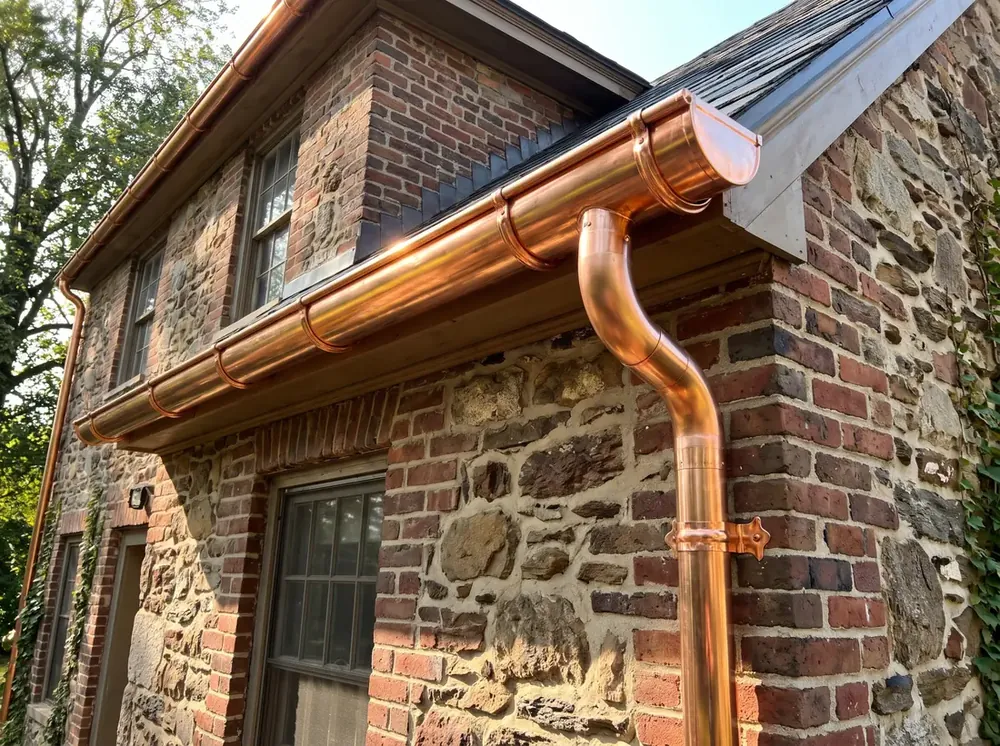
Copper gutters are made from 16 oz or 20 oz copper sheet (weight per square foot), most often in a half-round profile, sometimes K-style or built-in box gutters. Joints are soldered, downspouts are copper, and brackets and fasteners must be copper or compatible.
Where copper suits Franklin houses
Copper turns up most on brick and stone homes and on landmark buildings. Franklin's historic districts include Hincheyville, listed in 1982 with 71 properties, and Lewisburg Avenue, added in 1988, along with the original town. On houses like these, copper can be the original material or the closest modern match. Churches and civic buildings use copper box gutters and collector heads too.
Copper compared
| Copper | Aluminum | Galvalume steel | |
|---|---|---|---|
| Life | Longest when well installed | Long | Long while coating holds |
| Dents | Soft; 20 oz better | Dents; .032 better | Most dent-resistant |
| Joints | Soldered | Sealed | Sealed or riveted |
| Appearance | Bright, then brown, then green | Painted | Painted |
| National price | About $25–$40/ft | About $9–$18/ft | About $6–$14/ft |
Prices from This Old House and Angi; national ranges. See the metals guide.
Parts
| Part | Meaning |
|---|---|
| Copper | Sheet sold by weight per square foot, usually 16 or 20 oz; weathers brown, then green |
| Half-round gutter | A tube cut in half, hung on brackets; typical of older houses |
| Box gutter | A deep rectangular gutter, often built into the eave on older or commercial buildings |
| Strap hanger | A bracket fixed to the roof deck under the shingles, used where there is no usable fascia |
| Outlet | The hole and flanged drop that feeds a downspout |
| Collector head | A box at the head of a downspout that gathers water from a scupper or gutter |
| End cap | The piece that closes the end of a run |
How copper is installed
- Assess the cornice, fascia and roof edge; masonry houses may need strap hangers.
- Plan slope and outlets, and confirm all flashing is copper or compatible.
- Set brackets at close spacing.
- Lay the troughs and solder corners, ends and outlets.
- Fit copper downspouts and brackets.
- Test with water.
Points to watch
- Mixed metals. Original copper with later aluminum downspouts or steel nails will corrode at the contact points.
- Staining. Plan discharge away from light stone steps and concrete.
- Hail. Copper dents; 20 oz holds up better on exposed roofs.
- Theft. Copper downspouts on empty or exposed buildings occasionally go missing.
- Historic review. In local historic districts, check whether the work needs a Certificate of Appropriateness.
Repairing old copper
Old copper often outlives its solder. Leaking joints can be cleaned and resoldered and damaged sections replaced. Ask whether the contractor solders; caulked repairs on copper do not last as long.
Copper through the years
New copper is bright. Within months it turns brown, and over many years it moves toward the green patina seen on old buildings. Some owners coat it to hold the brown; most let it weather. Water running off copper can stain light stone, brick or concrete below, so plan where downspouts discharge.
Where copper is used on Franklin houses
| House | Copper use |
|---|---|
| Historic brick downtown or in Hincheyville | Half-round gutters, round downspouts, collector heads |
| Stone or brick estate | Full copper system |
| Traditional-style home | Copper on a bay window or porch roof as an accent |
| Mixed-material roof | Copper only where no aluminum flashing touches it |
Cost in context
National guides put copper at about $25 to $40 a foot installed, several times aluminum. On a 180-foot house that is roughly $4,500 to $7,200 before extras, as an illustration of national ranges rather than a quote.
Copper and theft
Copper downspouts at ground level are sometimes stolen in some areas. Ask whether lower sections can be secured or swapped for a painted lower length.
Questions to ask about copper
- Is it 16 or 20 oz copper?
- Are joints soldered or sealed?
- Are brackets, straps and fasteners copper or compatible?
- How will the flashing be handled where it meets the gutter?
- Can lower downspout sections be secured?
Copper on porches and bays
Many owners use copper only where it shows most: a front porch roof, a bay window or the main entry. A short copper run costs far less than a whole-house system and gives the house a focal point. Keep the copper section separate from aluminum or galvanized parts, and run its downspout where staining below will not matter.