
On this page
What downspouts do
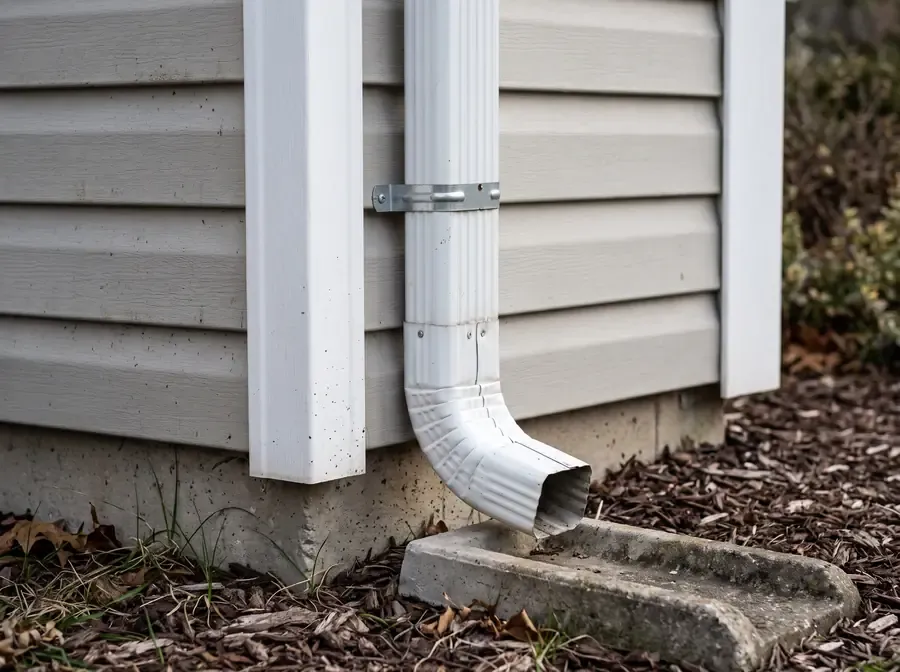
A downspout carries water from the gutter outlet to the ground. It is turned with A and B elbows, held to the wall with straps, and finished with an extension, splash block or buried drain line. The gutter moves water to the corners; the downspout decides its fate.
Sizes and types
| Downspout | Typical use |
|---|---|
| 2x3 inch rectangular | 5-inch gutters, smaller roofs |
| 3x4 inch rectangular | 6-inch gutters, large or steep roofs |
| 3 or 4 inch round | Half-round gutters, copper |
| 4x5 inch and up | Commercial roofs |
Larger downspouts pass leaves and seeds more easily, which matters under Franklin's hardwoods.
Where the water should go
Water released at the wall soaks down beside the foundation and can reach a crawl space or basement. The City of Franklin's stormwater program lists green infrastructure practices such as rain gardens that let roof water soak into the ground away from the house, and the city's own inspection checklists cover downspout disconnection as a stormwater practice.
| Option | Good for | Watch for |
|---|---|---|
| Splash block | A short throw onto lawn | Too short alone near crawl spaces |
| Extension | Moving water several feet out | Mowers, tripping |
| Flip-up extension | Paths and mowing | Must be put back down |
| Buried line to pop-up emitter | Long distance, tidy | Clogs; needs a cleanout |
| Buried line to daylight | Sloping lots | Needs a clear fall to an outlet |
| Rain barrel | Garden water | Fills fast; needs overflow |
| Rain garden | Letting water soak in | Placed away from the foundation |
Franklin's ground and water
Franklin is built along the Harpeth River and its tributaries, and low areas flood in big events: the Harpeth rose 25 feet at Franklin in about 15 hours in March 2021. Gutters do not change river levels. What they control is whether the roof adds its own water beside the walls, which on low lots and slopes is often the difference between a dry and a damp crawl space.
Parts
| Part | Meaning |
|---|---|
| Downspout | The pipe that brings water down, commonly 2x3 or 3x4 inches, or round on half-round systems |
| A and B elbows | Downspout bends; an A elbow turns in or out from the wall, a B elbow turns left or right |
| Downspout strap | A band or bracket holding the downspout to the wall |
| Extension | An added length that carries water away from the foundation |
| Splash block | A pad under the downspout that spreads the flow |
| Buried drain line | Pipe run underground from the downspout to a pop-up or an open outlet |
| Pop-up emitter | A spring lid at the end of a buried line that lifts to let water out |
| Cleanout | A removable fitting that gives access to clear a clog |
How downspouts are installed
- Choose outlet positions so each serves a fair share of roof and lands where water can drain.
- Cut and seal the outlet.
- Fit elbows to bring the pipe back to the wall.
- Strap the downspout top, middle and bottom.
- Add the discharge, above or below ground.
- Check the grade so ground slopes away.
- Test with water.
How many downspouts?
Signs you need another:
- Overflow at the outlet end while the far end stays calm.
- Long eaves with only one outlet.
- A valley draining into the same run.
- An upper roof emptying onto a lower gutter.
Mistakes to avoid
| Mistake | Result |
|---|---|
| Downspout onto a driveway | Runoff to the street, slick concrete |
| Extension aimed at the neighbor | Disputes and a wet neighbor |
| Buried line with no cleanout | A clog that cannot be cleared |
| Downspout next to a crawl space vent | Water under the house |
| Rain barrel with no overflow route | Overflow at the wall |
Downspouts on typical Franklin houses
| House | Typical downspouts |
|---|---|
| One-story brick home | Two to four 2x3 or 3x4 drops |
| Two-story with bonus room | Five to eight 3x4 drops |
| Historic house | 3 or 4-inch round, with collector heads on some |
| Commercial building | Large rectangular or round, anchored well |
Colors and placement
Downspouts are the most visible part of the system from the street. Matching them to brick or siding rather than trim makes them disappear. Placing them at inside corners or behind shrubs, rather than across a window, helps too.
Questions to ask about downspouts
- How many drops, and where?
- 2x3 or 3x4?
- Where will each one release water, and how far out?
- Will buried lines have cleanouts?
Upgrading from 2x3 to 3x4
The upgrade means a larger outlet cut in the gutter, new elbows, new straps and new extensions. It roughly doubles the opening and lets leaves and seeds pass instead of wedging in the elbows. On many Franklin houses it is the single most effective change for overflow at the outlet end.