
On this page
What half-round gutters are
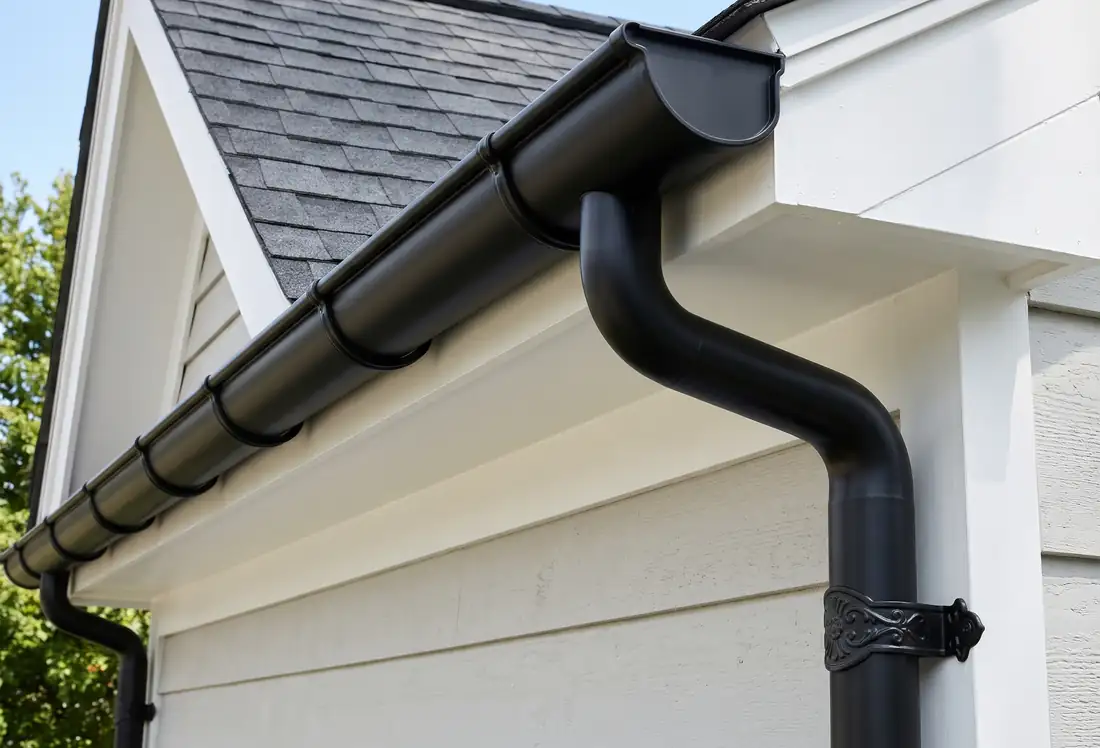
Half-round gutters are, as the name says, a tube cut lengthwise. They hang on brackets, drain through round downspouts with smooth elbows, and were the standard gutter before K-style took over in the mid-20th century. Franklin's Historic District Design Guidelines describe them as typical of pre-1960 houses.
Where they fit in Franklin
Franklin has five National Register districts and seven local historic districts, from the 16-block downtown to Hincheyville, Lewisburg Avenue, Adams Street, Boyd Mill Avenue, Everbright Avenue and the nearly two-mile Franklin Road district. Many houses there have steep main roofs, porches and wood cornices where half-round looks right. See Hincheyville, Lewisburg Avenue and downtown Franklin.
Half-round compared with K-style
| Half-round | K-style | |
|---|---|---|
| Profile | Semicircle | Flat back, shaped front |
| Hanging | Visible brackets or straps | Hidden hangers |
| Downspouts | Round, 3 or 4 inch | Rectangular, 2x3 or 3x4 |
| Capacity at the same width | Less | More |
| Appearance | Traditional | Modern standard |
| Metals | Aluminum, steel, copper | Mostly aluminum and steel |
| Cost | Usually higher | Lower |
Parts
| Part | Meaning |
|---|---|
| Half-round gutter | A tube cut in half, hung on brackets; typical of older houses |
| Strap hanger | A bracket fixed to the roof deck under the shingles, used where there is no usable fascia |
| End cap | The piece that closes the end of a run |
| Outlet | The hole and flanged drop that feeds a downspout |
| Downspout | The pipe that brings water down, commonly 2x3 or 3x4 inches, or round on half-round systems |
| Copper | Sheet sold by weight per square foot, usually 16 or 20 oz; weathers brown, then green |
| Drip edge | Bent metal strip at the edge of the roof deck that steers runoff into the trough |
| Half-round component | Note |
|---|---|
| Brackets (shank and circle) | Fascia-mounted or roof-strap; close spacing under valleys |
| Outlet tube | Round drop soldered or sealed to the trough |
| Round elbows | Smooth bends that clog less |
| Downspout brackets | Hold round pipe off the wall |
| End caps | Plain or decorative |
How half-round is installed
- Inspect fascia, cornice and rafter tails; older houses often need carpentry first.
- Set bracket positions on a slope toward the outlets.
- Hang the trough, seamless or in sections.
- Join corners and outlets by soldering (copper) or sealing.
- Fit round downspouts on brackets.
- Test with water.
Design review in historic districts
In Franklin's local historic districts the Historic Zoning Commission issues Certificates of Appropriateness for exterior work covered by its guidelines, and staff can approve some minor changes administratively. Changing gutter profile or material on a contributing building is the kind of thing to ask about first. See gutters on historic homes in Franklin.
Cost
Half-round costs more per foot than K-style in the same metal, and copper half-round sits at the top; national guides put copper at roughly $25 to $40 a foot installed (This Old House). These are national ranges. Carpentry on old cornices can add significantly.
Questions to ask
- Aluminum, steel or copper, and what gauge or weight?
- Bracket type and spacing?
- Seamless or sectional, and how are joints made?
- What carpentry will the cornice or rafter tails need?
- Will you prepare the information for a Certificate of Appropriateness?
Half-round on newer Franklin houses
Half-round is not only for historic homes. Builders in traditional-style neighborhoods such as Westhaven use it on cottage and Craftsman designs, and owners of brick homes sometimes choose it when replacing K-style. It costs more per foot than K-style and needs brackets at close spacing, but the round profile and round downspouts give a softer look.
Half-round sizes and capacity
| Size | Typical use |
|---|---|
| 5-inch half-round | Porches, cottages, small roofs |
| 6-inch half-round | Most houses; the usual choice on two-story homes |
| 7-inch or larger | Very large roofs, some estates |
A 6-inch half-round holds less water than a 6-inch K-style of the same width, so outlets and downspouts need to be generous: 4-inch round downspouts are common.
Half-round mistakes to avoid
- Using rectangular downspouts with round gutters, which looks wrong and fits poorly.
- Spacing brackets too far apart; half-round needs close support.
- Undersizing outlets, which limits capacity more than the gutter.
- Mixing copper half-round with aluminum flashing.
Upkeep
Half-round is easy to keep clean: its round bottom flushes well, and brackets are visible for checking. Look at bracket fasteners every couple of years, reseal or resolder joints that start to drip, and keep downspouts and outlets clear, since round outlets are smaller than many rectangular ones.