
On this page
- What causes sagging
- Why sags matter here
- How a sagging run is rehung
- Fastening parts
- Sags on different Franklin houses
- Can I fix it myself?
- Sags after storms
- How far apart hangers should be
- What a rehang includes
- When sagging means replacement
- DIY or call a contractor?
- Mistakes that bring the sag back
- Sagging and guards
What causes sagging
A gutter sags when its support is not up to the load. In Franklin that load is mostly wet leaves and water, plus the occasional limb.
| Cause | What you see | Fix |
|---|---|---|
| Spikes backing out | Gaps at spike heads, wavy runs | Replace with hidden hangers |
| Hangers too far apart | Dips between hangers | Add hangers |
| Wet leaf weight | Sag where debris sits | Clean, rehang, guards |
| Standing water | Sag at a low spot | Reset slope |
| Rotten fascia | Gutter tilting away | Replace fascia, rehang |
| Ladder damage | A kink at one spot | Replace the section |
| Fallen limb | A bent run | Replace the section |
Why sags matter here
Standing water in summer means mosquitoes; in any season it means a gutter that overflows at the low point and soaks the board behind it. Franklin's frequent heavy rain and big hardwoods keep gutters loaded.
How a sagging run is rehung
- Empty and clean the run.
- Probe the fascia; soft wood is replaced. See fascia and soffit.
- Remove old spikes and seal the holes.
- Snap a new slope line toward the outlet.
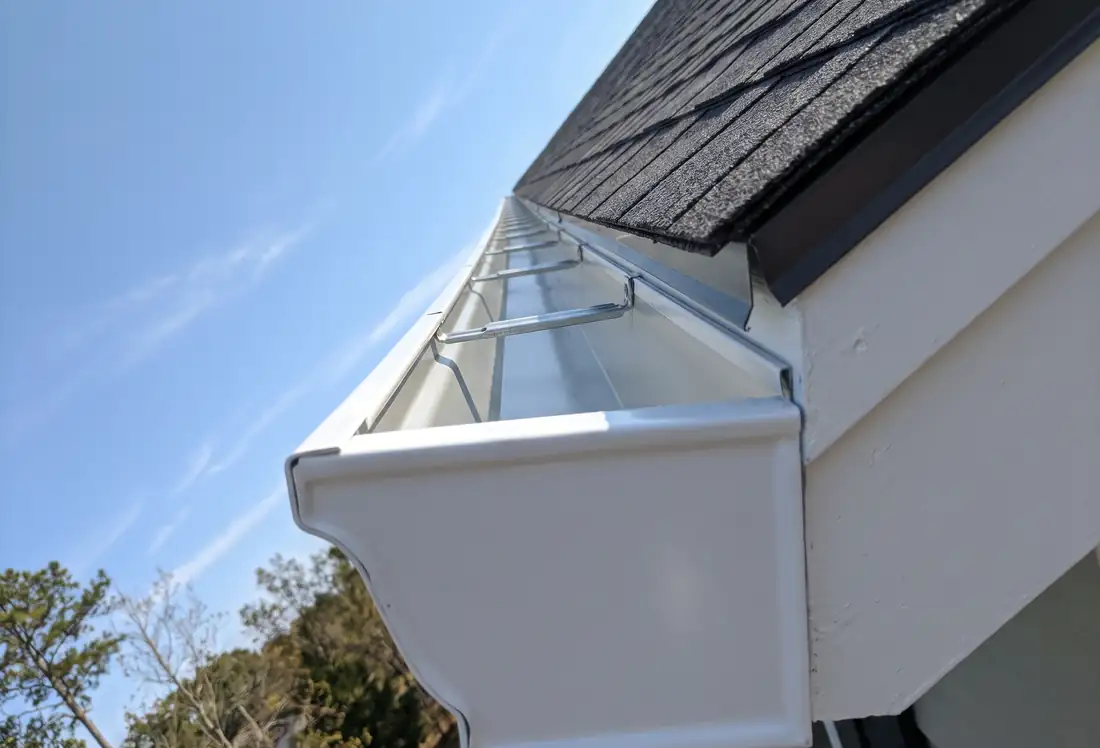
- Fit hidden hangers into sound fascia or rafter tails with long screws, about every two feet, closer at corners.
- Straighten or replace bent lengths.
- Test with water.
Fastening parts
| Part | Meaning |
|---|---|
| Hidden hanger | An internal bracket that clips to the gutter lip and screws through the back into the fascia |
| Spike and ferrule | Older fastening method of a long nail driven through a sleeve; works loose over time |
| Strap hanger | A bracket fixed to the roof deck under the shingles, used where there is no usable fascia |
| Fascia | The trim board across the rafter ends; hangers screw into it |
| Rafter tail | The exposed or boxed-in end of a rafter behind the fascia |
| Slope | The fall along a run toward the outlet, often about a quarter inch in ten feet |
Sags on different Franklin houses
| House | Common sag cause |
|---|---|
| Older home downtown or in Hincheyville | Spikes in old, patched fascia |
| 1980s–90s brick home | Original spikes or widely spaced hangers |
| Two-story under big oaks | Leaf weight in long runs |
| Newer home | Builder hanger spacing, ladder damage |
Can I fix it myself?
On a one-story house, adding a few hidden hangers into sound fascia is a reasonable DIY job. Resetting the slope on a long run, two-story work or fascia replacement is better left to a contractor.
Sags after storms
Wind lifts gutter ends, and limbs land on runs. A gutter that has been hit often sags at one spot rather than along the whole run. On streets with mature oaks and maples, limb damage is a common cause.
How far apart hangers should be
| Situation | Typical spacing |
|---|---|
| Standard run | About 24 inches |
| Corners and ends | Closer, often within 12 inches of the corner |
| Under valleys | Closer, where water and debris land hard |
| Under trees | Closer, for leaf weight |
What a rehang includes
A proper rehang means emptying the gutter, pulling old spikes, sealing the holes, fixing any soft wood, snapping a new slope line, then fitting hidden hangers with screws long enough to reach solid wood. A quick fix that drives the old spikes back in usually sags again within a year or two.
When sagging means replacement
If the gutter is kinked, cracked at the bends, or sags in several places along a run that also leaks at the joints, replacement is usually better value than a rehang.
DIY or call a contractor?
| Job | DIY on a one-story? | Better left to a pro |
|---|---|---|
| Adding two or three hidden hangers into sound fascia | Yes | Two-story work |
| Resetting the slope on a long run | Possible with care | Runs over 30 feet |
| Replacing a kinked section | Hard without matching coil | Usually |
| Fascia replacement | No | Yes |
Mistakes that bring the sag back
- Driving the old spikes back into the same holes.
- Screwing hangers into soft wood or only into the fascia face on thin boards.
- Leaving the gutter full of wet debris after rehanging.
- Setting the run level, so water sits in the middle.
Sagging and guards
Guards add a little weight, and a gutter full of debris under a guard adds more. If a guarded gutter starts sagging, lift a few panels and check for packed debris and loose hangers before rehanging.