
On this page
- Leiper's Fork in brief
- About Leiper's Fork
- Buildings
- Trees and creeks
- Outbuildings
- Booking a contractor in Leiper's Fork
- Which gutters suit houses in Leiper's Fork?
- A gutter calendar for Leiper's Fork
- How much gutter does a Leiper's Fork house need?
- Gutter jobs that come up in Leiper's Fork
- Roads, water and landmarks in Leiper's Fork
- Signs a Leiper's Fork house needs gutter work
- What a visit usually involves
- Before you call about Leiper's Fork
- Nearby
Leiper's Fork in brief
| Where | Southwest of Franklin, near the Natchez Trace Parkway |
| Settled | Late 1700s land grants |
| Post office | Named Leiper's Fork in 1818 |
| Historic district | National Register, July 1, 1998, about 18 acres |
| Population | About 650 |
| Main gutter issues | Historic buildings, farmhouses, barns, trees |
About Leiper's Fork
Leiper's Fork grew from late-18th-century land grants along the creek of the same name. Known earlier as Hillsboro, it took the name Leiper's Fork when the post office was renamed in 1818. The village's historic district, about 18 acres, was placed on the National Register on July 1, 1998. Around 650 people live there, and the Natchez Trace Parkway runs nearby.
Buildings
The village is a row of old frame and brick buildings, many now shops, galleries and restaurants, with farmhouses, barns and newer country homes on the surrounding land. Older buildings often have half-round or simple K-style gutters; barns frequently have none.
Trees and creeks
Leiper's Fork sits in a creek valley under big hardwoods. Leaves, twigs and storms fill gutters fast. Creek-side ground stays wet, so downspouts need to carry water away from old foundations and crawl spaces.
Outbuildings
Gutters on barns, shops and run-in sheds keep roof water from eroding the ground at the walls and from soaking hay or equipment inside.
Booking a contractor in Leiper's Fork
Calls about Leiper's Fork go to an independent gutter contractor who covers Williamson County. Some charge a trip fee for addresses farther from Franklin, so it is fair to ask on the call. After a storm that hits several towns at once, contractors book in the order calls come in, so ring early and keep your photos. Seamless runs are formed on a trailer next to the house; if the drive is long, steep or gated, say so.
Which gutters suit houses in Leiper's Fork?
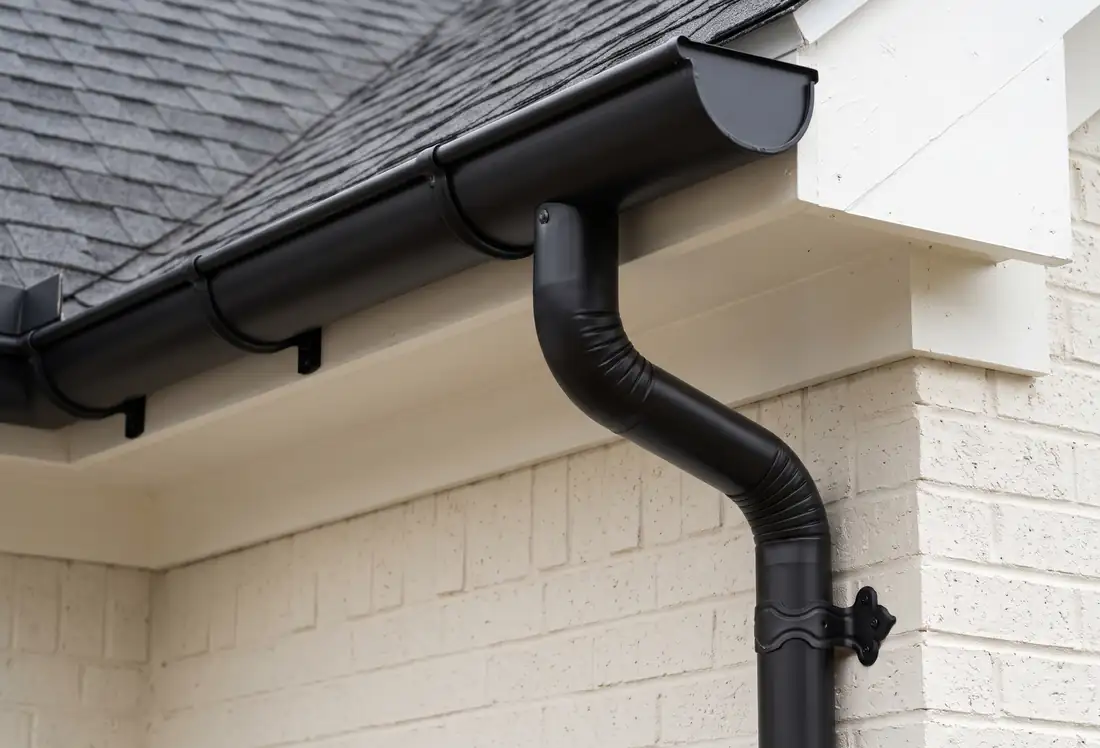
Older village buildings suit half-round or simple K-style; farmhouses and barns suit 6-inch aluminum or steel with long discharge.
| Typical choice in Leiper's Fork | |
|---|---|
| Gutter | Half-round on historic buildings; 6-inch K-style on homes and barns |
| Metal | Aluminum, copper on some buildings, steel on barns |
| Downspouts | Round on historic; 3x4 elsewhere |
| Fastening | Brackets or hidden hangers into sound wood |
| Guards | Under big hardwoods |
| Cleaning | Twice a year or more |
| Where water goes | Away from old foundations, toward open ground |
| Watch for | Leaves, fascia rot, wet creek-side ground |
| Rules | Gutter replacement rarely needs a permit; ask the contractor, and check with the local building office for drainage or structural work |
A gutter calendar for Leiper's Fork
The nearest official climate site, Nashville, averages 50.51 inches of precipitation a year, with May the wettest month at about five inches. Snow is light, around 4.7 inches in a typical winter, but ice storms happen. Here is how that plays out in Leiper's Fork.
| Months | What to look at in Leiper's Fork |
|---|---|
| March–April | Spring storms arrive; check outlets, corners and anything loosened over winter |
| May | Usually the wettest month; clear seeds and catkins before it and watch for overflow |
| June–August | Thunderstorms, wind and hail; look for dents, lifted runs and storm limbs |
| September–October | Good months to book replacement; check extensions and grading |
| November–December | Clean after hardwood leaves; flush every downspout |
| January–February | Cold snaps and the odd ice storm; watch shaded north eaves; never chip ice off a gutter |
How much gutter does a Leiper's Fork house need?
Gutters are priced by the foot, so the eave length sets most of the cost. Below are typical lengths for houses here, multiplied by national ranges from Angi. They show the scale of a job; they are not quotes.
| House | Typical eave length | Gutter | National range installed |
|---|---|---|---|
| Historic village building | 100–160 ft | 5-inch seamless aluminum | about $900–$2,080 |
| Farmhouse | 150–220 ft | 6-inch seamless aluminum | about $1,800–$3,960 |
| Barn or shop | 100–200 ft | 6-inch seamless aluminum | about $1,200–$3,600 |
Take-down of old gutters, fascia carpentry, extra downspouts, buried lines and guards are priced on top.
Gutter jobs that come up in Leiper's Fork
| House | What goes wrong | What usually fixes it |
|---|---|---|
| Village building | Old half-round leaking | New half-round, matching color |
| Farmhouse | Fascia rot, spikes | Repair, rehang |
| Barn | No gutters, eroded ground | Steel gutters, downspouts |
| Country home | Leaves | Guards |
Roads, water and landmarks in Leiper's Fork
- Roads: Old Hillsboro Road, Pinewood Road, Leiper's Creek Road
- Places: The Natchez Trace Parkway nearby
- Neighbors: Westhaven, Fairview, Thompson's Station
Signs a Leiper's Fork house needs gutter work
- Water sheets over the front of the gutter in moderate rain, or only below one valley.
- Stains, peeling paint or soft wood along the fascia.
- Gaps between the gutter and the roof edge, or runs that dip between hangers.
- Mulch and soil washed out at the end of a downspout.
- A damp or musty crawl space or basement after storms.
- Seedlings or grass growing in the trough.
What a visit usually involves
The contractor walks the house, looks at each run from the ground and a ladder, checks the fascia and drip edge, and notes where every downspout lets go. They then explain what they found and give their own written quote, usually with options such as repair, partial replacement or a full new system. Nothing is decided on the call; you choose after seeing the quote.
Before you call about Leiper's Fork
- Note which side of the house the problem is on, and whether it happens in every rain or only in downpours.
- Look at where each downspout releases water and whether the ground runs back toward the house.
- After a storm, photograph the damage and write down the date.
- Know how many stories the house has and whether there is a basement, crawl space, deck or porch roof.