
On this page
- How each is made
- Side by side
- Where sectional gutters fail
- Why seamless suits most Franklin houses
- When sectional still makes sense
- How long each lasts
- Upgrading from sectional to seamless
- Joint terms
- Questions to ask a contractor
- Seamless and sectional on Franklin houses
- Telling which you have
- Common seamless myths
- Questions about an existing sectional system
How each is made
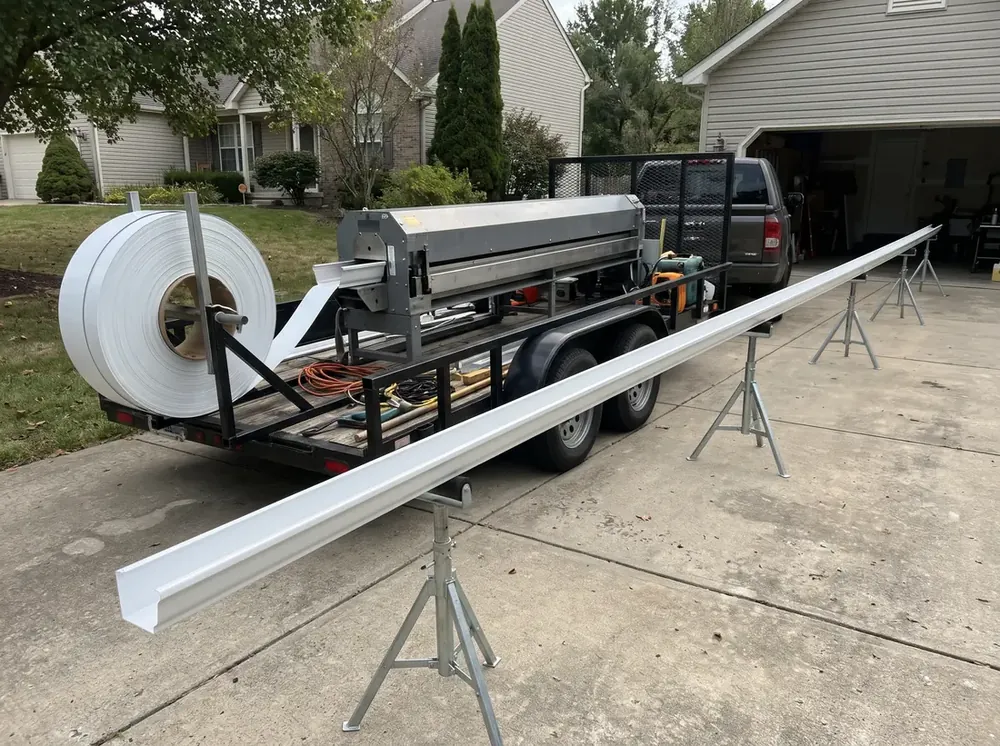
Seamless gutters are formed on site from a coil of flat metal fed through a roll-forming machine, usually on a trailer or truck parked beside the house. The installer measures each eave and runs off one length to fit. Sectional gutters are bought in pre-cut lengths, typically 10 or 20 feet, and joined with connectors and sealant.
Side by side
| Seamless | Sectional | |
|---|---|---|
| Joints on a 40 ft eave | Two end caps, an outlet | Three or more joints plus caps and outlet |
| Leak points | Corners, ends, outlets | Every joint as well |
| Made | On site to length | Off the shelf |
| Metals | Aluminum, steel, copper | Aluminum, steel, vinyl, copper |
| Look | Clean, continuous line | Visible joint lines |
| DIY friendly | No; needs the machine | Yes |
| National installed price | about $9–$18 a foot (aluminum) | Often a little lower |
Ranges from Angi and This Old House.
Where sectional gutters fail
Each sectional joint relies on sealant between overlapping pieces. In Franklin's long hot summers the metal expands and contracts every day, and over the years sealant dries and cracks. The result is a drip every 10 or 20 feet, usually first on the sunniest side of the house. Joints also catch debris, and water sitting at a joint shortens its life further.
Why seamless suits most Franklin houses
- Fewer leak points on long eaves common on two-story homes.
- A cleaner line that suits brick and traditional-style houses.
- Sized and colored to the house, with 5-inch or 6-inch and matching downspouts.
- Hung on hidden hangers spaced for heavy rain and leaf loads.
When sectional still makes sense
| Situation | Why sectional can work |
|---|---|
| A small porch or shed | Short run, few joints |
| A quick DIY repair | Off-the-shelf parts |
| Matching an existing sectional system | Same parts |
| Vinyl on an outbuilding | Low cost |
How long each lasts
Lifespan depends more on installation, fascia and upkeep than on whether the run is seamless. Sealed sectional joints are usually the first part of any system to need attention. Aluminum seamless gutters on sound fascia, hung on hidden hangers and kept clean, commonly last a long time.
Upgrading from sectional to seamless
- Remove the old gutters and check the fascia behind.
- Repair or replace soft fascia. See fascia and soffit.
- Check the drip edge.
- Measure each eave and decide on size; see 5-inch vs 6-inch.
- Form and hang the new runs with the right slope.
- Add downspouts where needed, and extend discharge.
Joint terms
| Term | Meaning |
|---|---|
| Miter | A corner joint where two runs meet, made from a strip, a box piece or cut by hand |
| End cap | The piece that closes the end of a run |
| Outlet | The hole and flanged drop that feeds a downspout |
| Hidden hanger | An internal bracket that clips to the gutter lip and screws through the back into the fascia |
| Slope | The fall along a run toward the outlet, often about a quarter inch in ten feet |
| K-style gutter | The most common modern profile: flat back, decorative front, 5 or 6 inches wide |
Questions to ask a contractor
- Will the gutters be formed on site?
- Where will the joints be?
- How are the miters made and sealed?
- What gauge of coil?
- How many outlets on each run?
More on seamless gutters in Franklin.
Seamless and sectional on Franklin houses
| House | Typical system |
|---|---|
| Builder home from the 1990s | Often seamless aluminum; some sectional |
| Older home with past DIY repairs | A mix of both |
| Newer subdivision home | Seamless aluminum |
| Barn or shed | Sectional steel or aluminum |
| Historic house | Seamless half-round or soldered copper |
Telling which you have
Look along the gutter from the ground. Joint lines every 10 to 20 feet, with sealant at each, mean sectional. A continuous run with joints only at corners and ends means seamless.
Common seamless myths
"Seamless never leaks." Corners, end caps and outlets are still joints.
"Sectional is always cheaper." Parts cost less, but installed prices are often close, and sectional joints need more upkeep.
"Seamless can't be repaired." Damaged sections can be cut out and replaced.
Questions about an existing sectional system
If you already have sectional gutters, ask: how many joints leak, whether the hangers are sound, whether the size suits the roof, and whether the fascia behind is solid. Sound sectional gutters with one or two leaking joints can be resealed. Many leaking joints usually mean replacing with seamless.