
On this page
What seamless gutters are
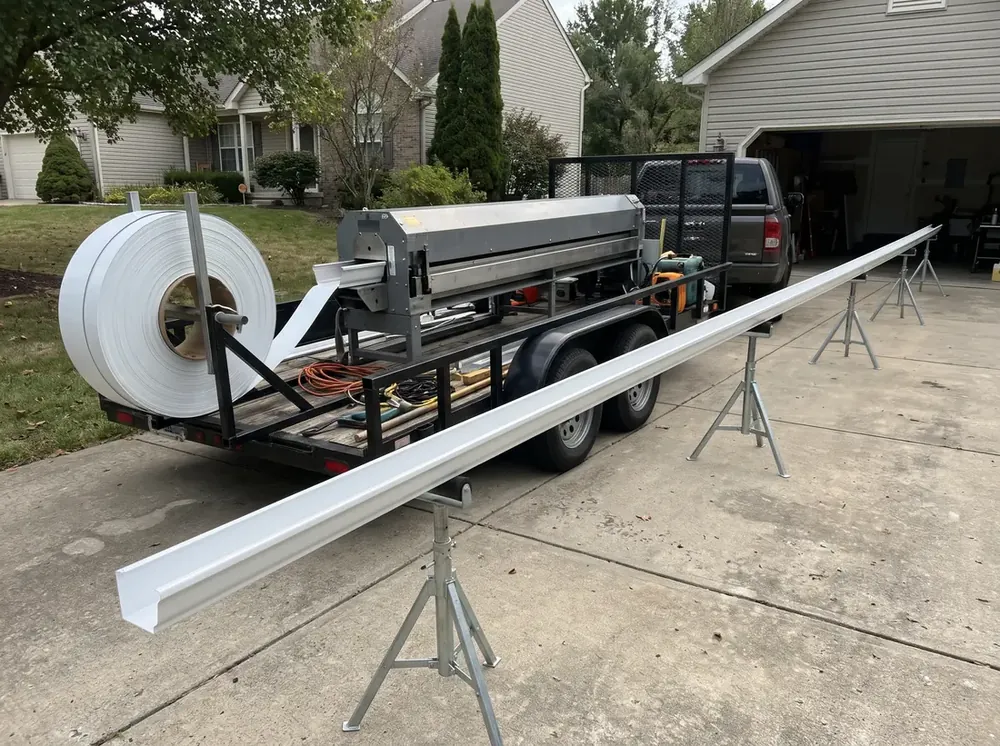
Seamless gutters are formed on site from a flat coil of metal, most often painted aluminum, by a roll-former on the installer's trailer. The installer measures an eave, feeds the coil through, and cuts the gutter to that length, so a 38-foot eave gets a 38-foot gutter. The only joints are the corners (miters), end caps and outlets.
Sectional gutters come in fixed lengths and are joined along the run with connectors and sealant, typically every 10 or 20 feet.
Why joints are the weak point
A joint is two pieces of metal held together by sealant and rivets. Sun and heat dry sealant out; cold makes it brittle; the metal grows and shrinks with every temperature swing. Franklin gets both hot summers and freezing nights in winter. A sectional system on a two-story house can have dozens of joints; a seamless one has a handful.
| Seamless | Sectional | |
|---|---|---|
| Joints along a run | None | Every 10–20 ft |
| Fit | Cut to each eave | Pieced together on site |
| Typical leak points | Corners and ends | Every connector, plus corners |
| Sizes | 5-inch, 6-inch, some half-round | Mostly 5-inch |
| Who installs | Contractor with a machine | Contractor or DIY |
| Cost per foot installed | Higher | Lower for materials |
More in seamless vs sectional.
How seamless gutters go up
- Measure every eave and plan outlet positions and slope.
- Check the fascia and drip edge, replacing rotten boards first.
- Roll each run from coil to length.
- Cut outlets and fit end caps, riveted and sealed.
- Form the corners as strip, box or hand-cut miters and seal them.
- Hang on hidden hangers into the fascia, roughly every two feet.
- Fit downspouts, elbows, straps and extensions.
- Test with a hose.
Parts of a seamless system
| Part | Meaning |
|---|---|
| K-style gutter | The most common modern profile: flat back, decorative front, 5 or 6 inches wide |
| Hidden hanger | An internal bracket that clips to the gutter lip and screws through the back into the fascia |
| Miter | A corner joint where two runs meet, made from a strip, a box piece or cut by hand |
| End cap | The piece that closes the end of a run |
| Outlet | The hole and flanged drop that feeds a downspout |
| A and B elbows | Downspout bends; an A elbow turns in or out from the wall, a B elbow turns left or right |
| Downspout strap | A band or bracket holding the downspout to the wall |
| Drip edge | Bent metal strip at the edge of the roof deck that steers runoff into the trough |
Size and metal
Most Franklin homes get 5-inch or 6-inch K-style in aluminum. Six-inch with 3x4 downspouts suits big or steep roofs; see 6-inch gutters. Standard coil is .027 inch; .032 is stiffer and dents less. Seamless steel and copper are available from some installers. See aluminum gutters.
Seamless gutters on typical Franklin houses
| House | Usual seamless setup |
|---|---|
| Brick ranch from the 1970s–80s | 5-inch, 3x4 downspouts at both ends of long runs |
| 1990s two-story, as in Fieldstone Farms | 5 or 6-inch, more outlets, extensions past landscaping |
| 2000s two-story with bonus room, as in McKay's Mill | 6-inch on main runs, diverters below valleys |
| Traditional-style newer home, as in Westhaven | 6-inch K-style or half-round to suit the style |
Common mistakes
- Too few outlets on long eaves, so the far end overflows in a storm.
- Corners left to a bead of caulk instead of being riveted and sealed.
- Hangers screwed into soft wood that will not hold.
- No fall, so water stands in the trough.
- Downspouts that dump beside the foundation.
Cost
National guides from Angi and This Old House put seamless aluminum at about $9 to $13 a foot installed for 5-inch and $12 to $18 for 6-inch. These are national ranges. Corners, height, fascia work and removal of old gutters add to it. See the Franklin cost guide.
What the quote should say
- Gutter size, metal, gauge and color
- How corners are made and sealed
- Hanger type and spacing
- Number and size of downspouts, and where each empties
- Whether old gutter removal is included
Seamless gutters through a Franklin year
| Season | What a seamless system faces | What helps |
|---|---|---|
| Spring | The wettest weeks, oak catkins and maple seeds | Clean troughs, enough outlets |
| Summer | Hot afternoons, thunderstorms, hail | Hangers close enough to stop the run twisting; .032 coil |
| Fall | Leaf drop from big hardwoods | Guards or extra cleaning |
| Winter | Cold snaps, the odd ice storm | Sound fascia and hangers, open downspouts |
Heat is easy to forget. A long aluminum run grows and shrinks a little every day in summer. Seamless runs have no joints to open up, but end caps and miters still flex, so they need riveting and good sealant rather than sealant alone.
How long a seamless job takes
Most one- and two-story houses are done in a day: old gutters off, fascia checked, runs formed and hung, downspouts fitted and tested. Fascia carpentry, copper, or a large house with many corners adds time. Ask the contractor how long they expect and whether any part waits on materials.