
On this page
Where gutters leak
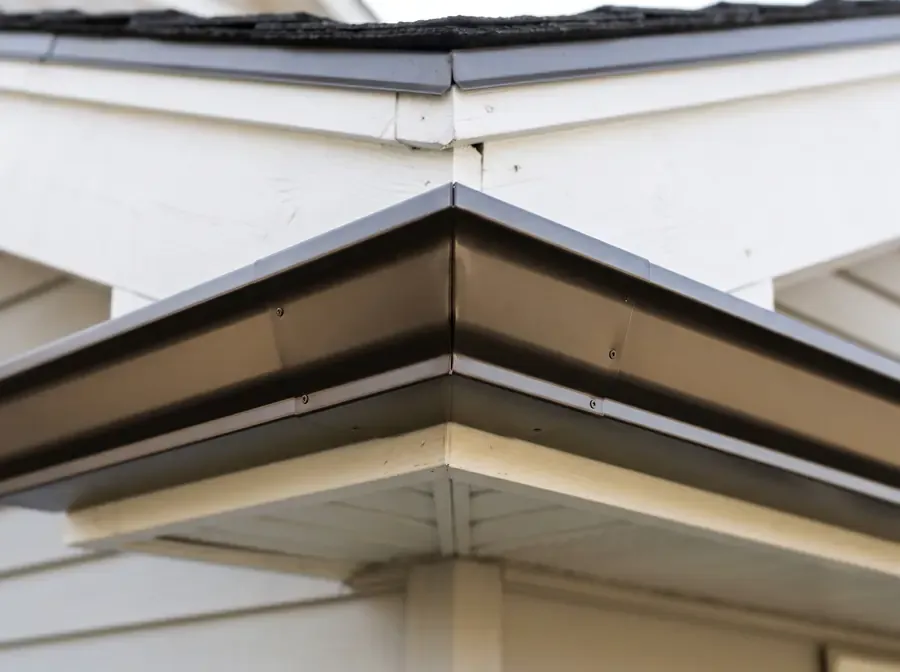
Leaks come from joints: miters at the corners, end caps, and outlets, plus every slip joint on a sectional system. They also come from holes made by limbs, ladders or misplaced screws, and from water sneaking behind the gutter where the drip edge is missing.
| Where it drips | Likely cause | Repair |
|---|---|---|
| A corner | Failed sealant at the miter | Clean and reseal, or new miter |
| The end of a run | End cap seal failed or cap loose | Re-crimp, rivet and reseal |
| Around a downspout | Outlet seal failed | Reseal or replace the outlet |
| Every 10–20 feet | Sectional joints | Reseal, or replace with seamless |
| Behind the gutter | No drip edge, gutter too low | Add drip edge or apron, rehang |
| Mid-run on seamless | Hole, split, screw | Patch or replace the section |
| Everywhere in a downpour | Overflow, not a leak | Clean, re-pitch or upsize |
Why Franklin gutters leak
Heat. Long hot summers dry sealant and make metal expand at every joint each afternoon.
Cold snaps. Winter freezes make old sealant brittle and open hairline cracks.
Impacts. Limbs, ladders and hail can split metal near joints. See storm damage.
Water load. Gutters that hold water because of a clog or poor slope keep joints wet, which shortens sealant life.
How a leak is repaired
- Find the real source with a hose; water often travels along the underside before dripping.
- Clean the joint to bare metal, removing old sealant, dirt and oxide.
- Dry it.
- Rivet loose corners, caps and outlets.
- Seal inside the joint with gutter sealant, tooled so water runs over it.
- Patch holes with a bedded metal patch, or replace the length.
- Test with water.
What a leak damages
| Leak location | What gets wet |
|---|---|
| Corner over a walkway | Steps and paths, which stay slick |
| End cap over a window | Trim, sill and the wall below |
| Outlet near the foundation | Crawl space or basement wall |
| Behind the gutter | Fascia, soffit, rafter tails |
| Over a deck or porch | Boards, posts and ledger |
Parts involved
| Part | Why it matters |
|---|---|
| Miter | A corner joint where two runs meet, made from a strip, a box piece or cut by hand |
| End cap | The piece that closes the end of a run |
| Outlet | The hole and flanged drop that feeds a downspout |
| Drip edge | Bent metal strip at the edge of the roof deck that steers runoff into the trough |
| Gutter apron | A wide flashing that slides under the first shingles and laps down into the gutter |
| Slope | The fall along a run toward the outlet, often about a quarter inch in ten feet |
Repair or replace?
A couple of leaking corners on sound gutters is a repair. Leaks at most joints, sectional seams everywhere, or rust through steel make replacement worth pricing. See repair or replace and seamless vs sectional.
Questions to ask
- Exactly where is the leak, and what is causing it?
- Will you take the old sealant out?
- What sealant and rivets do you use?
- Is the drip edge doing its job?
Leaks on different Franklin houses
| House | Where leaks usually start |
|---|---|
| 1990s brick home, original gutters | Corners and end caps on the sunny side |
| Older home with sectional gutters | Every joint |
| Historic house with half-round | Bracket holes and soldered seams |
| Newer home | Outlets where downspouts were knocked |
How long a reseal lasts
A corner cleaned to bare metal, riveted and resealed with proper gutter sealant typically lasts many years. A bead of caulk smeared over the old joint can fail within a season. If the same corner has been patched twice, a new miter is usually the better fix.
Leaks you can check yourself
- Run a hose into the gutter on a dry day.
- Watch the underside of every corner, end and outlet.
- Mark drips with tape so you can point them out.
- Look for water running down the fascia behind the gutter.
Sealants and fasteners
Gutter sealant is made to stay flexible on metal through heat and cold. General-purpose caulk often hardens and cracks. Rivets hold joints together so the sealant only has to seal, not glue. Ask what the contractor uses; a good answer names a gutter sealant and aluminum rivets for aluminum gutters.
Leaks and hail
Hail can crack sealant at corners and dent metal near joints, so leaks sometimes start right after a storm. If several corners begin dripping at once after hail, mention it to your insurer and the contractor, since it may be part of storm damage rather than age.