
On this page
- What a 6-inch gutter is
- Why Franklin roofs often need it
- 5-inch and 6-inch compared
- Gutter or downspout?
- Parts that change
- Installation
- Common Franklin houses that benefit
- The downside to plan for
- A worked example
- Signs your house needs 6-inch
- Color and look
- Questions to ask about 6-inch
- Does 6-inch cost much more?
What a 6-inch gutter is
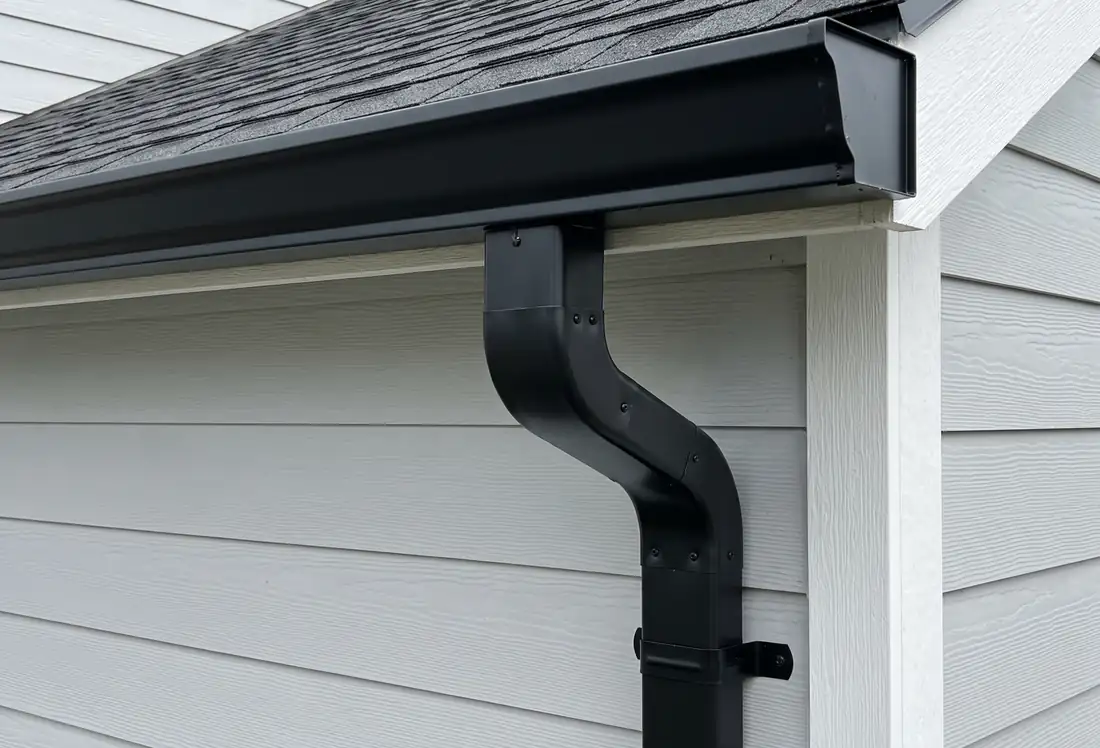
A 6-inch gutter is a K-style gutter measuring 6 inches across the top, an inch wider than the common residential size. It is paired with 3x4-inch downspouts, whose opening is twice that of a 2x3. Together they carry far more water per minute, which is what matters in a Middle Tennessee downpour.
Why Franklin roofs often need it
Nashville's weather records include 0.95 inches in five minutes and 1.60 inches in fifteen. That is the kind of intensity that overwhelms small gutters. Six-inch makes sense when:
- The roof is large or steep.
- A valley concentrates two slopes onto one short stretch of gutter.
- A second-story or bonus-room roof empties onto a lower roof.
- Eaves are long and have few downspouts.
- The gutters overflow even when clean.
5-inch and 6-inch compared
| 5-inch K-style | 6-inch K-style | |
|---|---|---|
| Usual downspout | 2x3 inch | 3x4 inch |
| Capacity | Suits modest roofs | Substantially more |
| Look | Fits one-story homes | Fits two-story and large roofs |
| Clog resistance | Smaller downspouts clog sooner | Larger downspouts pass more debris |
| National price | About $9–$13/ft | About $12–$18/ft |
Prices from Angi and This Old House; national figures. Full comparison in 5-inch vs 6-inch.
Gutter or downspout?
| Where it overflows | Probable cause | Possible fix |
|---|---|---|
| Near the downspout | Downspout too small or blocked | 3x4 downspout, extra outlet |
| Below a valley | Concentrated flow | Valley diverter, 6-inch section |
| Along a long run | Not enough capacity or slope | 6-inch, more outlets |
| Only when full of leaves | Debris | Cleaning, guards |
Parts that change
| Part | Meaning |
|---|---|
| Outlet | The hole and flanged drop that feeds a downspout |
| Downspout | The pipe that brings water down, commonly 2x3 or 3x4 inches, or round on half-round systems |
| A and B elbows | Downspout bends; an A elbow turns in or out from the wall, a B elbow turns left or right |
| Valley diverter | A small baffle that keeps fast valley water from shooting past the gutter |
| Hidden hanger | An internal bracket that clips to the gutter lip and screws through the back into the fascia |
| Extension | An added length that carries water away from the foundation |
Installation
The process is the same as any seamless job: fascia check, outlet planning, slope, roll forming, hanging, corners, end caps, downspouts and a water test. The difference is downstream: more water reaching the ground faster means extensions and buried lines matter more.
Common Franklin houses that benefit
| House | Why 6-inch helps |
|---|---|
| Two-story with a bonus room over the garage | Upper roof dumps onto the garage roof |
| Steep roof with several valleys | Concentrated flow at valley outlets |
| Long ranch eave with one downspout | All water heads to one outlet |
| Large traditional-style home | Big roof planes, tall eaves |
The downside to plan for
A bigger gutter puts more water on the ground. If downspouts end beside the wall, upgrading can make a damp crawl space worse. Plan the discharge at the same time. See downspout drainage and your foundation.
A worked example
Take a two-story house with a bonus room over the garage. The main roof drains its back slope into a 45-foot eave and the front slope into a garage roof below. In a fifteen-minute burst like the 1.60 inches on Nashville's record list, the garage gutter takes water from two roof planes. With 5-inch gutter and one 2x3 downspout, it overflows at the corner. With 6-inch and a 3x4 downspout at each end, it usually keeps up.
Signs your house needs 6-inch
- Water pours over the front even when the gutter is clean.
- Overflow is worst below valleys or at a lower roof.
- Downspouts roar in storms but the gutter still fills.
- Beds and mulch wash out below one particular corner.
Color and look
Six-inch gutters show more face. Matching them to the trim or fascia color makes them read smaller, which matters on houses with narrow trim. On brick homes, a downspout color matched to the brick hides the larger 3x4 pipe.
Questions to ask about 6-inch
- Will all runs be 6-inch, or only some?
- Will downspouts be 3x4?
- What gauge of coil?
- How many outlets on the longest run?
Does 6-inch cost much more?
National guides put 6-inch seamless aluminum at about $12 to $18 a foot installed against $9 to $13 for 5-inch. On a 220-foot house, that difference is roughly $660 to $1,100 at the national rates, before downspouts. Set against repeated overflow, fascia rot and wet crawl spaces, many owners of large two-story homes find it worth it.